

You’ve just started a new job in the UAE. HR hands you an insurance card, tells you it’s a “group medical policy in Dubai“, and that’s about it. No booklet. No walkthrough. Just a plastic card and a vague sense that you’re “covered”. Covered for what, exactly?
That question trips up more expats than you’d think. Group medical insurance is one of the best perks of working in the UAE, but the word “covered” hides a lot of small details. Some plans pay for almost everything. Others only meet the legal minimum, leaving you to cover the rest yourself.
This guide walks through what a typical group medical insurance policy in Dubai and across the UAE actually includes, what usually sits outside the benefits list, and how to check your own policy before you’re sat in a waiting room hoping the bill won’t sting.
What Does UAE Group Medical Insurance Usually Cover?

Most group medical policies in Dubai and the wider UAE are built around a core set of benefits. Think of this as the foundation every medical insurance for the employees plan is meant to have, before you even get into the extras.
In broad terms, a standard policy will pay for doctor visits, hospital stays, tests, medicines, and emergency care. How generously it pays, and whether you’ll owe a share of the bill, depends entirely on your specific plan.
Outpatient Consultations
This is the bread-and-butter benefit. GP visits, follow-ups, and specialist appointments booked through a referral usually fall under outpatient cover.
Some policies ask for a small co-payment here, often a flat fee or a percentage of the consultation cost. It’s worth checking whether your plan requires a GP referral before you can see a specialist. Skip that step on some policies, and the claim gets rejected.
Inpatient and Hospital Treatment
If you’re admitted to hospital, this is where the real financial protection kicks in. Surgery, room charges, surgeon and anaesthetist fees, and intensive care are typically included, subject to your policy’s annual limit.
Room category matters more than people expect. A “standard” plan might only cover a shared room. Want a private room? You may need to top up the difference yourself, or your employer may have chosen a plan that already includes it.
Diagnostic Tests and Scans
Blood work, X-rays, ultrasounds, CT and MRI scans generally sit under diagnostics, provided a doctor has deemed them medically necessary. Insurers are fairly strict about that last part. A scan ordered “just to be sure” without clinical justification can sometimes be declined.
Prescription Medicines
Medicines prescribed by a treating doctor are usually covered, though almost every UAE policy sets an annual cap and a co-payment percentage. Buy from a pharmacy outside your insurer’s approved network, and you might end up paying upfront and claiming reimbursement if it’s reimbursable at all.
Emergency Medical Care
Emergency treatment, including ambulance transport in many plans, is a standard inclusion. But “emergency” has a specific meaning to insurers. It generally means a genuine, immediate threat to life or health, not simply an inconvenient time to see a GP.
Dubai’s health insurance framework requires every policy to spell out benefits, financial ceilings, provider networks, and co-insurance in writing. That’s precisely why the policy document, not the insurance card, is where the real answers live.
What Additional Benefits Can Expats Get Under a Group Health Insurance Plan?
Here’s where basic and enhanced corporate plans really start to diverge. Two colleagues at the same company can have wildly different experiences depending on which tier their employer has chosen and, often, which of the best group medical insurance company in the UAE options that employer picked in the first place.
Maternity and Newborn Care
Pregnancy consultations, prenatal appointments, delivery and newborn care can be included, but only on plans that specifically offer maternity benefits. Many policies apply a waiting period, often around nine to twelve months from the start date, before maternity cover kicks in.
Don’t assume it’s automatic. The UAE’s basic scheme, introduced for certain private-sector and domestic workers, specifically excludes pregnancy and childbirth. If starting a family is on the horizon, this is one detail worth confirming with HR long before you need it.
Dental Treatment
Routine check-ups, fillings and extractions are common on enhanced plans, though usually capped at a modest annual limit. Basic policies often skip dental entirely or cover emergency treatment only.
Optical Benefits
Eye tests, glasses and contact lenses tend to appear as a fixed annual allowance rather than unlimited cover. It might be a few hundred dirhams a year, enough for a basic pair of glasses, not designer frames.
Chronic and Pre-Existing Conditions
This worries a lot of expats moving to the UAE with diabetes, asthma, or a past surgery on their medical history. The good news: the UAE’s basic scheme provides cover for chronic and pre-existing conditions without a waiting period.
That said, individual employer plans can still word things differently, and some insurers apply their own conditions around ongoing management of a chronic illness. Read your specific policy rather than assuming the basic scheme’s rules apply automatically to your employer’s plan.
Telemedicine and Mental Health Support
Video and phone consultations have become far more common since the pandemic reshaped how people access healthcare. Some plans now include a set number of mental health sessions too, though this remains far from universal across the market.
All these extras – maternity cover, dental, optical, and chronic condition support – come at a price, and that price varies more than most people expect from one plan to the next. Once you know which benefits actually matter to you, the next logical question is what you’ll actually pay for them.
If you’re trying to work out how premiums are calculated and what factors push your cost up or down, our guide on How to Calculate Your Health Insurance Cost breaks that down step by step.
What Isn’t Covered by UAE Group Medical Insurance?
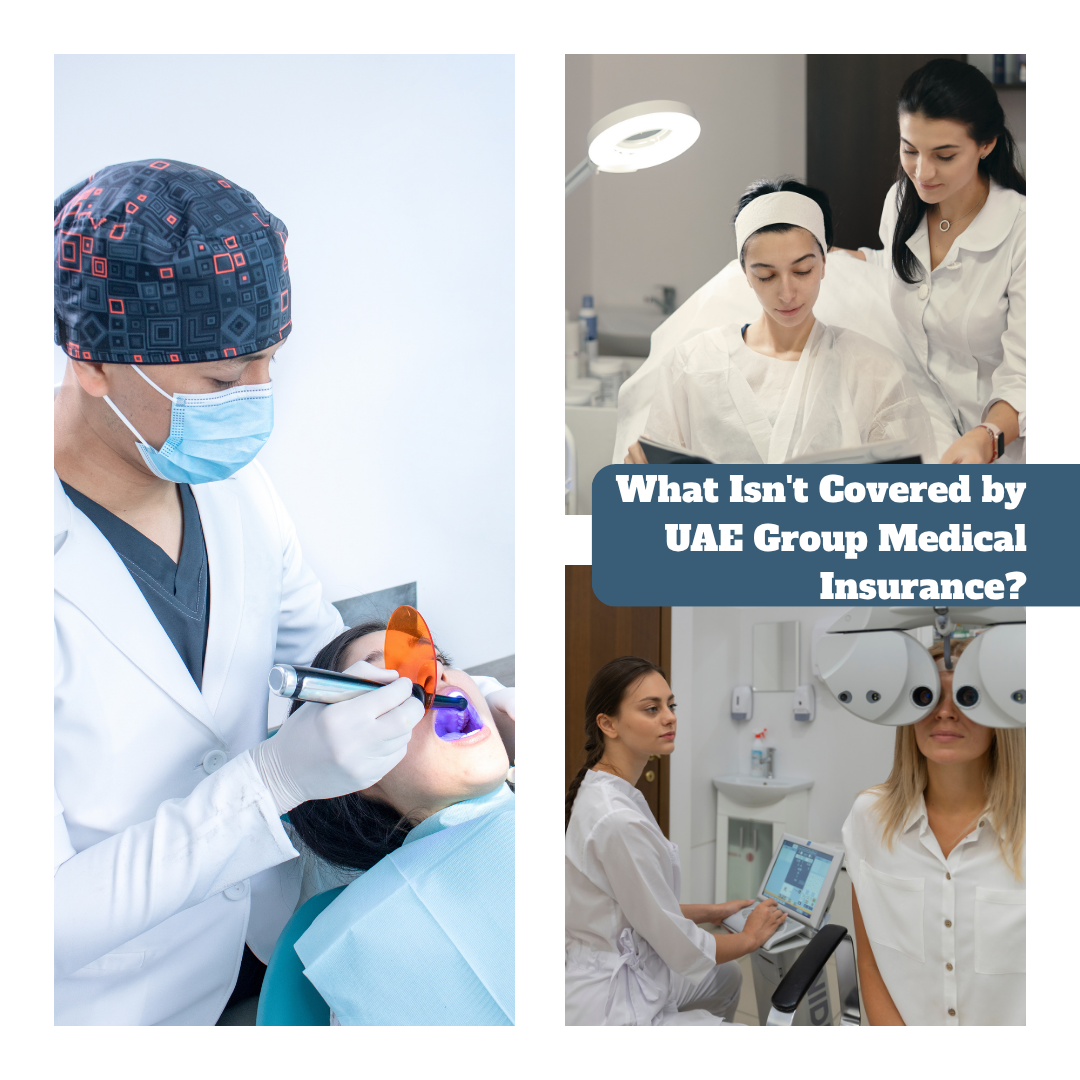
Nearly every rejected claim you’ve heard about from friends and colleagues traces back to one of the issues below with their medical insurance policy. Understanding them upfront saves a lot of frustration later.
Common Exclusions
Depending on the policy, you’ll typically find these left out:
- Cosmetic procedures
- Non-medically necessary treatment
- Certain elective surgeries
- Experimental or unproven treatments
- Some dental and optical extras
- Treatment received outside the approved provider network
- Medicines bought without a prescription
Common Policy Limits to Check
Beyond outright exclusions, limits shape what you’ll actually receive:
- Annual coverage limit – the total the insurer will pay in a policy year
- Co-payment – your fixed share of a bill, often 10–20%
- Deductible – an amount you pay before cover starts
- Coinsurance – a percentage split between you and the insurer
- Waiting periods – time before certain benefits activate
- Pre-authorisation – insurer approval needed before some treatments
How Can Expats Check What Their UAE Group Medical Insurance Covers?

Reading your policy shouldn’t feel like solving a puzzle, but for a lot of expats, it does. The good news is that most of the confusion clears up once you know exactly where to look and which questions to ask. A few minutes spent checking now can save a lot of hassle at the hospital reception later.
Check Your Policy or Member Handbook
Look specifically for the benefits schedule, whether it’s a corporate plan or individual medical insurance. It lists exactly what’s included, the limits attached, and any co-payment percentages. This document usually matters more than anything printed on your insurance card.
Check the Hospital and Clinic Network
Before booking treatment, confirm your chosen hospital, specialist, and pharmacy sit within your insurer’s network. Out-of-network care can mean paying upfront and claiming later, sometimes at a reduced reimbursement rate.
Ask HR or Your Insurer These Questions
A short list to keep handy:
- What’s my annual coverage limit?
- Which hospitals and clinics can I use?
- What’s my co-payment percentage?
- Is maternity included, and is there a waiting period?
- Are dental and optical benefits part of my plan?
- How are pre-existing conditions treated?
- Do I need pre-authorisation for specific treatments?
- Is emergency treatment covered outside the UAE?
- Are my dependants included, or do I need to arrange separate cover?
- What happens to my insurance if I leave the company?
Understand Basic vs Enhanced Cover
Meeting the UAE’s mandatory insurance requirement isn’t the same as having comprehensive protection. Employers can, and often do, offer coverage well above the legal minimum. Dubai’s framework specifically allows for this kind of supplementary cover. The gap between the two tiers can be significant, particularly around maternity, dental and room categories during a hospital stay.
Conclusion
Insurance is one of those things nobody thinks about until they’re standing at a hospital reception, unwell and slightly anxious about the bill. That’s precisely the wrong moment to discover your plan doesn’t cover the treatment you need or that a 20% co-payment applies.
Take twenty minutes now. Pull up your policy document, find the benefits schedule, and check the points covered above. If anything’s unclear, ask HR directly, they’d rather answer a quick question today than deal with a confused, frustrated employee mid-treatment.
For employers, this is also worth a second look. Choosing a plan that only meets the bare legal minimum might save money on paper, but it often shows up later as lower staff satisfaction or unexpected costs for employees who assumed they were fully protected. Reviewing your group medical insurance options periodically is a small effort that tends to pay off in employee trust.