
Imagine you have started working in your new job, moved into your new home, and landed in Dubai to start your new future. But then your visa is denied because you did not show any proof of health coverage. Such situations are not unusual for new residents in the United Arab Emirates.
Insurance for new UAE residents is not something optional, rather, it is a requirement to reside in the UAE. Most new residents are unaware of the exact conditions of insurance, such as which insurance companies are authorised and which emirate’s law applies to them, who is responsible for paying the premium, and what to do in case of a denied visa application.
This article aims to explain what insurance is required for a residency visa on a per-emirate basis. By the end of the article, readers will have a good comprehension of the rules that apply to them.
Is Health Insurance Really Mandatory in the UAE?
Yes, health insurance is mandatory for UAE residency. It has been compulsory for the residents of Dubai ever since the Health Insurance Law was passed in 2013. However, there has been a recent development concerning the Dubai Health Insurance Law. The new law was effective from 1 January 2025, and it extends the scope of the existing law to cover all emirates as a result of a decision made by the federal cabinet.
Therefore, employees working in the private sector, as well as their sponsors, in Sharjah, Ajman, Umm Al Quwain, Ras Al Khaimah, and Fujairah will mandatorily need to apply for compliant health insurance before obtaining or renewing a residency visa. It cannot be added as an optional cover at a later stage.
Apart from insurance policies that cover essential health needs, many companies opt to invest in Business Insurance in the UAE to secure their operations in the future. This type of business coverage is not mandatory but reduces the chances that a firm will shut down due to various preventable factors like property loss, liabilities, employee-related incidents, and others.
Why Did the UAE Make Health Insurance Compulsory?
- Public hospitals can’t bear the financial burden for the uninsured — mandatory insurance shifts a share of that financial burden off the public budget.
- It also limits a related problem: uninsured residents often delay or avoid treatment due to high private healthcare costs, which can worsen outcomes and drive up emergency costs later.
Health Insurance Rules by Emirate
This is where most of the confusion sits, understandably, because each emirate has historically run its own system.
Is Health Insurance Mandatory in Dubai?
Moreover, this is the most tightly regulated of the seven emirates. Firstly, every residency visa holder (employees, self-employed residents, Golden Visa holders, and their dependents) is required to carry a Dubai Health Authority (DHA)-approved insurance policy.
Secondly, employers are obliged to cover the insurance of their employees, although they might not be responsible for their dependents. Finally, note that the Federal Authority for Identity, Citizenship, Customs and Port Security (ICP) now automatically checks insurance records when a visa application or renewal is submitted, so there is no way around presenting appropriate documents for renewal.
Is Health Insurance Mandatory in Abu Dhabi?
Also yes, under the Department of Health (DoH), the emirate’s system is traditionally more restrictive than that of Dubai, which means that sponsors are obligated to cover dependants in most cases. Abu Dhabi was the first emirate to introduce mandatory cover, so the culture around it is better ingrained.
Sharjah, Ajman, and the Northern Emirates
These emirates were relatively lax on enforcement for a considerable period, but this policy is about to change. Starting with the new year, private sector staff and domestic workers must also carry health insurance policies. This is an important detail to keep in mind if you are relocating to Sharjah or any of the Northern Emirates in the future.
How to Choose the Right Insurance Policy?
For many, price will be the primary differential factor and often the least important. A cheaper premium with a smaller network, higher deductibles, or more limited benefits may well end up costing significantly more in the moment of claim.
The right comparator here would be legal requirements. Once these are met, focus on differences in benefits during claims, not on price. The details in the fine print are often telling:
- Pre-existing conditions.
- Maternity waiting periods and specific exclusions.
- Modes of claims settlement (direct billing vs reimbursement) can be critical to cash flow at the hospital counter.
- Reputation, and not necessarily size, is often the best proxy for service quality in the event of a dispute.
- Lastly, read the policy wording. Not exactly light reading, but a good place to find the finer details.
How to Buy Insurance Online in the UAE?
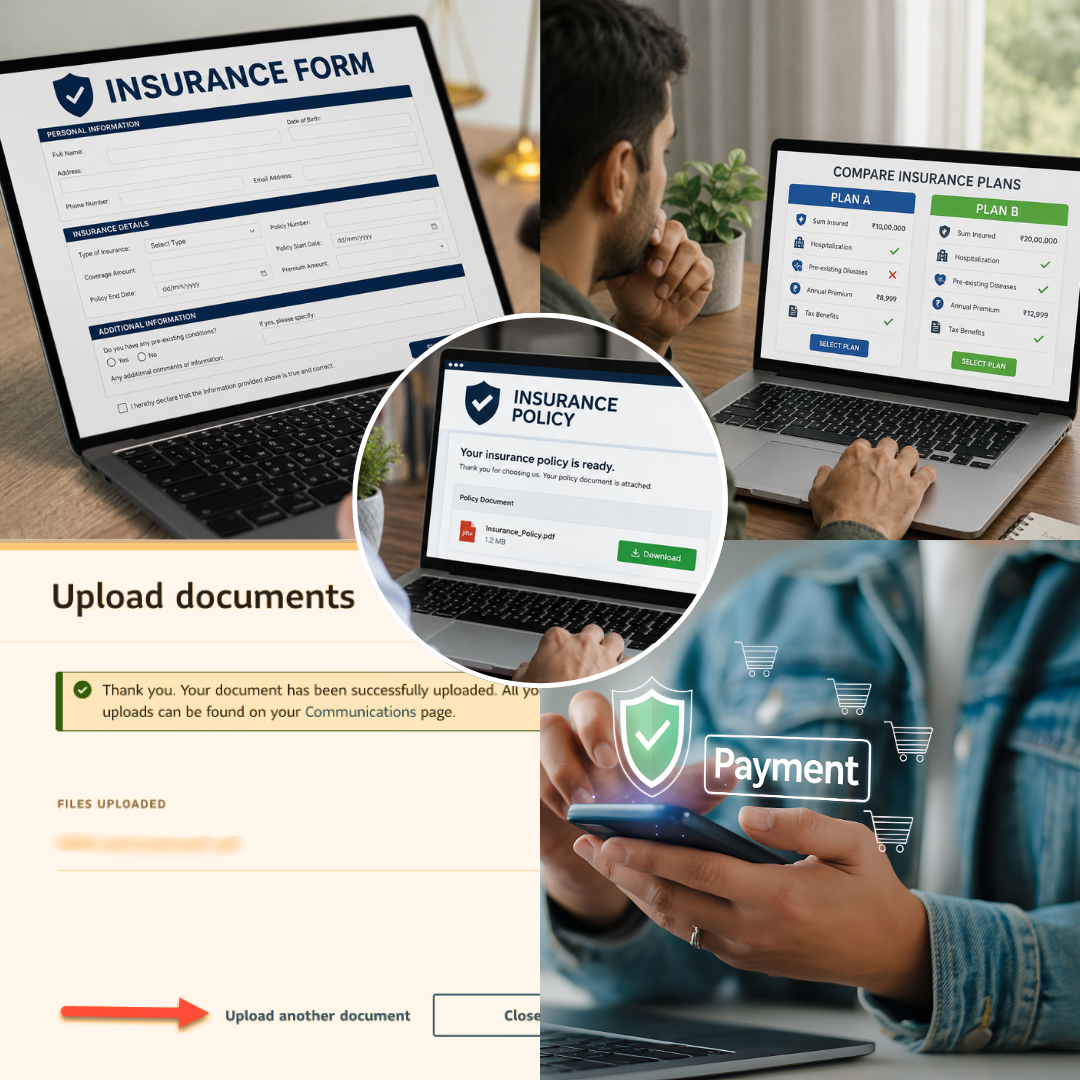
Step 1
Identify What You Need
Health, motor, travel, business, or a combination.
Step 2
Compare Plans
Look at coverage, premiums, deductibles, and network hospitals or garages side by side.
Step 3
Get an Instant Quote
Enter your personal and policy details and review the options presented.
Step 4
Upload Your Documents
Typically, your Emirates ID (or application receipt), passport copy, UAE visa, and — depending on the policy — a driving licence, vehicle registration, or business licence.
Step 5
Pay Securely Online
Choose your payment method, and you’ll usually receive confirmation instantly.
Step 6
Download Your Policy
Save a digital copy somewhere you can find it quickly — you’ll need it for visa renewals, hospital visits, or vehicle registration.
If you’re self-employed, between jobs, or your employer doesn’t offer cover, Individual Medical Insurance in the UAE is the way to go. You can get access to quality healthcare that fits within your budget, offers the coverage and options you need, and works with the hospitals and medical facilities you want to use.
How to File an Insurance Claim in the UAE?
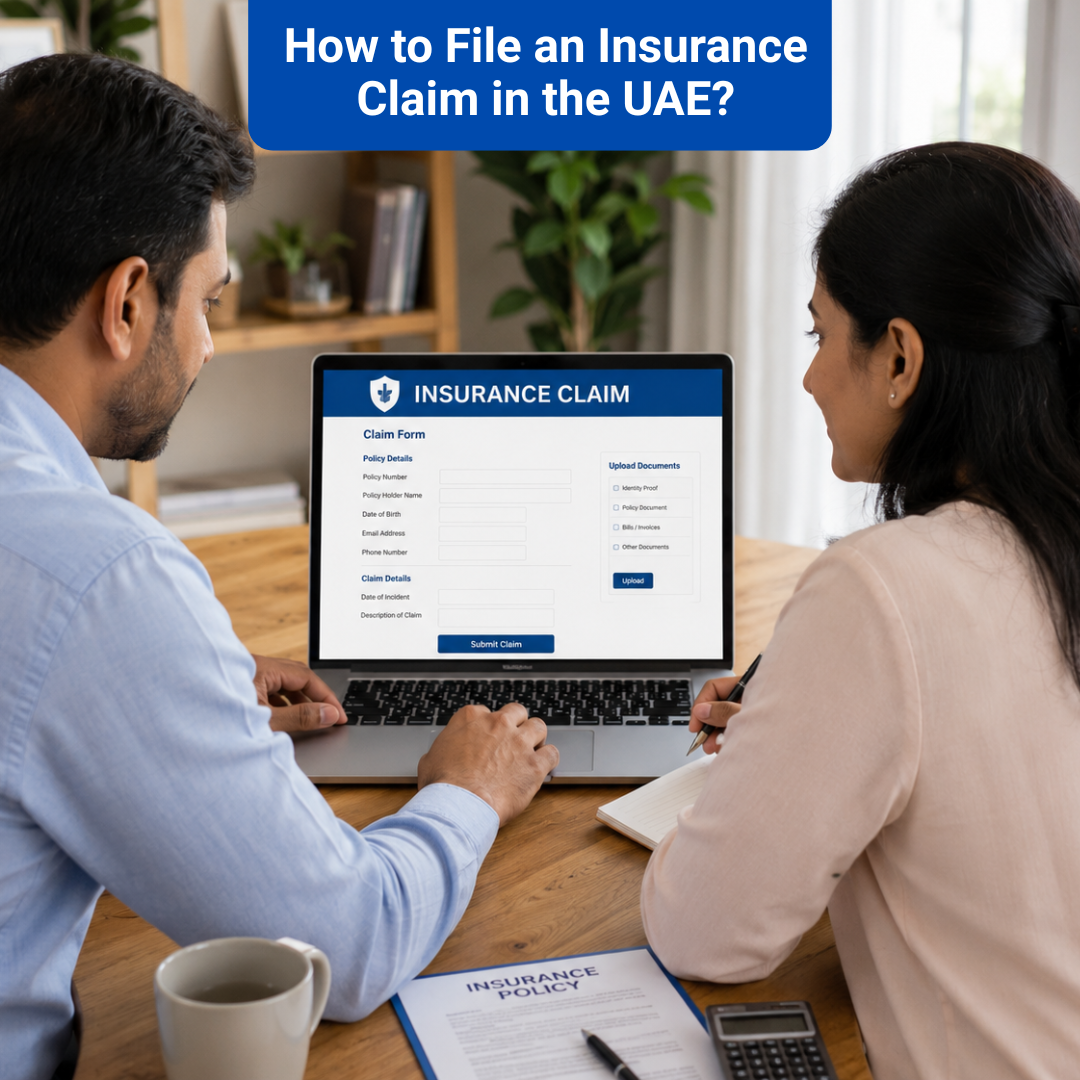
Step 1
Notify Your Insurer Immediately
Most policies specify a reporting window, and missing it can jeopardise the claim entirely.
Step 2
Gather Your Documents
This might mean a police report for a vehicle accident, medical reports for a health claim, photos of damage, or repair estimates.
Step 3
Submit the Claim
Through the insurer’s online portal, mobile app, email, or customer service line, most UAE insurers now offer at least two of these.
Step 4
Wait for Assessment
The insurer verifies your documents, arranges an inspection if needed, and checks the claim against your policy terms.
Step 5
Receive Settlement
This could mean repair authorisation, medical reimbursement, direct settlement with a hospital, or a compensation payment, depending on the type of claim.
For Car Insurance Claims in the UAE, the process may also include vehicle inspections, repair approvals at authorised garages, or direct settlement between the insurer and the repair centre. Having the right policy in place can help minimise out-of-pocket expenses and get you back on the road as soon as possible.
Common Mistakes New UAE Residents Should Avoid
- Choosing a policy based only on the cheapest premium while not considering excluded items.
- Not reviewing exclusions until a claim needs to be made.
- Allowing a policy to lapse between renewals.
- Giving false medical information when applying for a policy.
- Failing to meet claim filing deadlines.
- Selecting a policy that legally covers you but offers inadequate benefits for your specific circumstance.
Choosing the right Health Insurance in the UAE is just as important as avoiding the mistakes mentioned above. Instead of simply seeking cheap insurance, consider plans that can help you find the best available healthcare treatments, have a vast network of hospitals and clinics, and have sufficient coverage for everyday use as well as any medical emergencies.
Benefits of Having the Right Insurance in the UAE
Being correctly covered brings benefits beyond the legal requirement. It reduces costs, which are often difficult to estimate. It also ensures access to the best healthcare in the UAE (not the minimum coverage), thus removing one more worry while arriving and settling down. The coverage makes life easier for a family in the long run since school, healthcare, and housing choices can be made with more ease.
If you have frequent business trips or vacations, you should consider buying Travel Insurance in the UAE. If you do, then you can rest assured that any mishap that occurs will not ruin your day. It can give you the much-needed security from medical expenses, cancellations, lost luggage, and travel delays, whether you are travelling locally or abroad.
Not all UAE insurance policies are created equal. Getting the wrong coverage can be costly. How Can Expats Choose the Best UAE Insurance Policy? Everything you need to know about coverage, benefits, and cost for expats in the UAE.
Conclusion
Insurance for new UAE residents is not a burden, as it serves to track healthcare, transportation, and commercial activity in the state, which is justified by an increase in the number of residents in the UAE. At the same time, arranging everything for the new arrival regarding health and motor insurance will save them a lot of hassle and time. To do this, it must be carefully compared and studied, and the best option chosen. It is also necessary to take into account the company’s licence in the emirate where the policyholder resides. By doing this, arranging insurance will be a non-issue for the new UAE arrival.